Good garden lighting serves two purposes: safety (lighting paths and steps) and atmosphere (making your garden beautiful at night). Together, they extend your outdoor living season by months.
Five types of garden lighting and when to use them
1. Path and step lighting (safety)
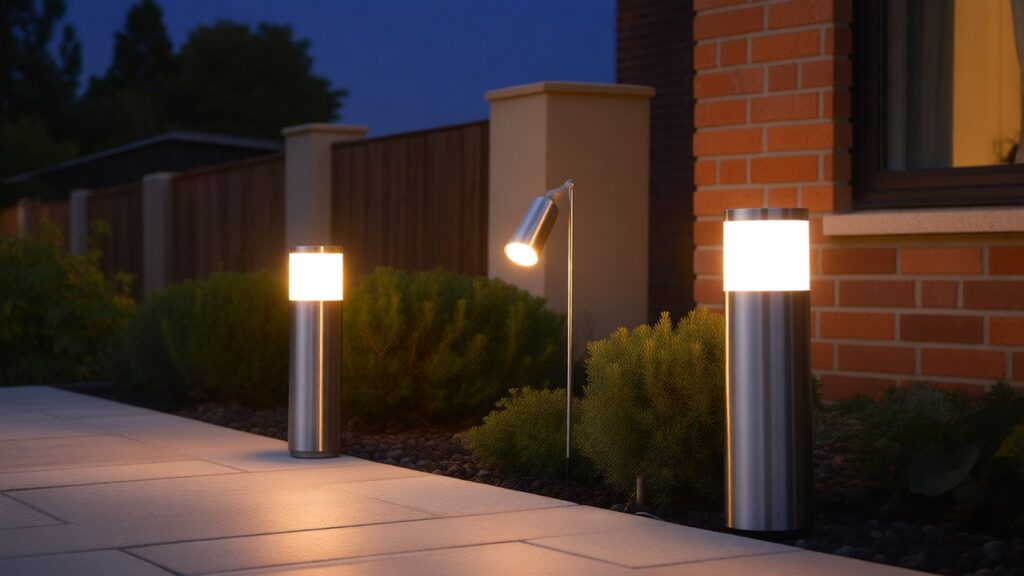
LED path lights, solar or mains-powered, light the route and stop people tripping. Space them 1.5–2 metres apart. Solar versions are the cheapest option because there is no wiring, but mains-powered LEDs are brighter and far more reliable through a Norfolk winter.
For steps, recessed lights in the tread (the horizontal part) or low spotlights aimed downward are safest. Aim for 50–100 lumens per light.
2. Uplighting (drama and features)
A spotlight pointed upward at a tree, shrub or wall creates drama and depth. A single uplight on a mature tree is a small job with a disproportionate effect — the fitting itself is inexpensive, and most of the work is in getting a cable to it.
3. Flood lights (broad area coverage)
A floodlight mounted high on a fence or wall lights a large area for a garden party or for the kids playing out. 400–800 lumens is typical. Floodlights can be harsh, so use a dimmer or a filter if you want the space to stay pleasant.
4. Festoon lights (ambience)
Decorative string lights hung across a patio or a pergola create a warm, inviting atmosphere for very little outlay. 50–100 lumens per bulb is about right, over a 10–15 metre run.
5. Deck and feature lights (accent)
Recessed lights in decking, low-voltage fittings in borders, or wall-mounted lights on garden structures — often dimmable or colour-changing. Price per fitting varies a lot with how sophisticated the control is.
Design principle: Layering
Like kitchen lighting, garden lighting works best in layers:
- Ambient: Soft general light (festoon strings, one large uplighting upward).
- Task: Path and step lighting (safety).
- Accent: Spotlights on features (trees, sculptures, water features).
Solar vs. mains: Pros and cons
Solar: No wiring, zero running cost, simple installation. Downside: dimmer, must be in sunlight to charge, batteries degrade over time (5–7 years).
Mains: brighter, more reliable, and can run on timers and dimmers. The downsides are the wiring itself (cost and disruption), a small running cost per fitting, and the Building Regulations notification.
Recommendation: Use solar for path lights (low-power, pure safety). Use mains for uplighting and feature lights (where brightness and reliability matter).
Color temperature and intensity
Warm white (2,700–3,000K): Inviting, cozy. Best for patios, decks, and entertainment areas.
Cool white (4,000K+): Clinical, harsh. Avoid for ambience; okay for security if you prioritize visibility over warmth.
Avoid bright white flood lights unless you’re lighting a large area for a party. Dimmers let you adjust intensity.
Installation considerations
- Power source: Solar is DIY. Mains requires an electrician and building regs approval for hardwired systems (but low-voltage systems under 50V are exempt).
- Cable routing: mains cables should run underground in protective ducting. The length of the run is the main thing that moves this.
- Outlet location: put a weatherproof outdoor socket somewhere useful so you can plug in lights or power tools without running a lead out of a window.
What a typical garden scheme includes
- Solar path lights — around ten of them, to mark the route.
- Mains uplighting — three spotlights into planting or trees, installed and wired.
- Festoon string — about 15 metres across the patio.
- A weatherproof outdoor socket and the wiring to reach it.
- Together that is a genuinely well-lit garden — and it is one visit, quoted as one fixed price.
Maintenance and longevity
LED lights last 25,000 hours and more — twenty-five years of evenings. Solar batteries degrade over 5–7 years and are cheap to replace. Mains-powered systems are virtually maintenance-free provided the wiring is properly protected.
Smart and color-changing lights
WiFi-enabled garden lights — Philips Hue, LIFX and similar — let you change colour and brightness from your phone. They carry a premium over a plain fitting, and they are worth it if you entertain often or like to change the mood of the space.
Bottom line: layer your garden lighting — solar path lights for safety, mains spotlights for drama, festoon strings for atmosphere. The result is a garden that is beautiful, safe, and usable from dusk onwards.